Junior Gold Format Explained: Singles, Doubles, Team, U Divisions
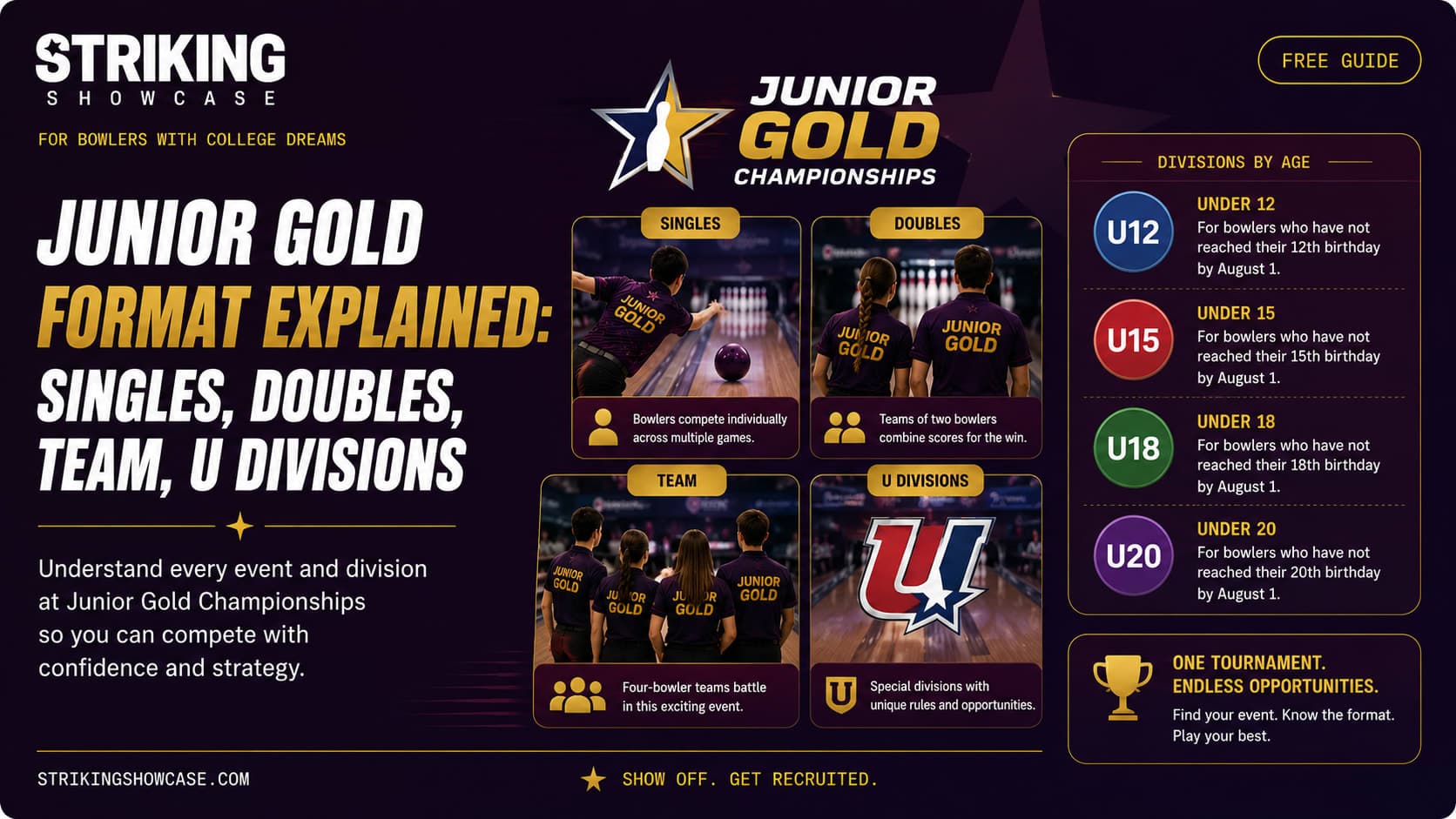
Junior Gold is a national-stage youth tournament but the format confuses first-time families every year. There are four age divisions, multiple lane patterns, a long qualifying block, a cut, and then match play. If you don't understand the structure, you'll feel lost by day two.
Here's exactly how Junior Gold works.
The Age Divisions (U-Divisions)
Junior Gold splits bowlers into four divisions by birthdate, separately for boys and girls:
U12 Boys / U12 Girls: bowlers age 11 and under as of August 1
U15 Boys / U15 Girls: bowlers age 12 to 14
U17 Boys / U17 Girls: bowlers age 15 to 16
U20 Boys / U20 Girls: bowlers age 17 to 20
You bowl against only your own division throughout the tournament. A U17 boy will never face a U20 girl. Each division has its own champion.
Qualifying: 15 Games, Three Blocks
The first three days of the tournament are qualifying. Every bowler in your division bowls 15 total games across three blocks of five games each. Each block uses a different lane pattern.
This is where preparation pays off. Bowlers who only practice on house shots tend to score well in one block and collapse in the others. Bowlers who've practiced multiple sport patterns adjust faster.
Your total pinfall (sum of all 15 games) determines whether you advance.
The Cut
After qualifying, each division cuts to a top group that advances to match play. The number who advance varies by division size typically the top 64, 128, or 256 bowlers in larger divisions.
If you miss the cut, your tournament is effectively over (some divisions have lower-bracket consolation, but the spotlight moves to advancers). If you make the cut, you bowl on.
Match Play (Head-to-Head)
Match play at Junior Gold is single-elimination head-to-head competition. You're paired against another bowler in your division. Whoever wins the match (highest score in a set number of games usually two-game match play with bonus pins per win) advances. Whoever loses is out.
This is a completely different format than qualifying. In qualifying, you bowl against the field. In match play, you bowl against one specific opponent which changes everything emotionally. Bowlers who excel in match play are usually the ones who can stay focused on their own shot and ignore what their opponent is doing.
The Finals
Each division crowns a champion through a final round of match play or a bracket-style finals. The U20 finals are typically televised or streamed nationally. Winning a U20 Junior Gold title is one of the most prestigious accomplishments in youth bowling and effectively guarantees scholarship offers.
Why the Format Matters for Recruiting
College coaches watch differently in each phase:
In qualifying: they watch your average and consistency across patterns
In match play: they watch your composure, decision-making, and how you handle pressure
In the finals: they watch how you carry yourself when the cameras are on
If you make match play, more coaches are watching you specifically. If you advance to the finals, every coach in attendance knows your name by the next morning.
What Parents Should Know
The format means very different things in terms of logistics:
Qualifying blocks can run 4–6 hours each pack accordingly
The cut day is emotional bowlers who miss it need space, not pep talks
Match play days are shorter but more intense
Your bowler's schedule may not be confirmed until the day before each round
Build your travel plans with flexibility in mind. The tournament can stretch from a five-day week to a full week depending on advancement.
Frequently Asked Questions
How many age divisions does Junior Gold have?
Four U12, U15, U17, and U20 split separately for boys and girls, based on the bowler's age as of August 1.
How many games do you bowl in Junior Gold qualifying?
15 total games, split across three blocks of five games each, with each block bowled on a different lane pattern.
What happens if you miss the cut at Junior Gold?
Your tournament is effectively over for the main bracket, though some divisions offer a lower-bracket consolation format. Bowlers who make the cut move on to match play.
How does match play work at Junior Gold?
Match play is single-elimination and head-to-head. You're paired against one opponent in your division, usually over a two-game set with bonus pins awarded per win, and the loser is eliminated.
Do all divisions have a televised final?
The U20 finals are typically the ones televised or streamed nationally, given the visibility around scholarship offers at that age group. Other divisions still crown champions through match play or bracket-style finals.
Why does the Junior Gold format matter for college recruiting?
Coaches watch different things at each stage consistency in qualifying, composure in match play, and poise in the finals. Advancing further means more coaches are watching you specifically.