Junior Gold Championships: A Complete First-Timer's Guide
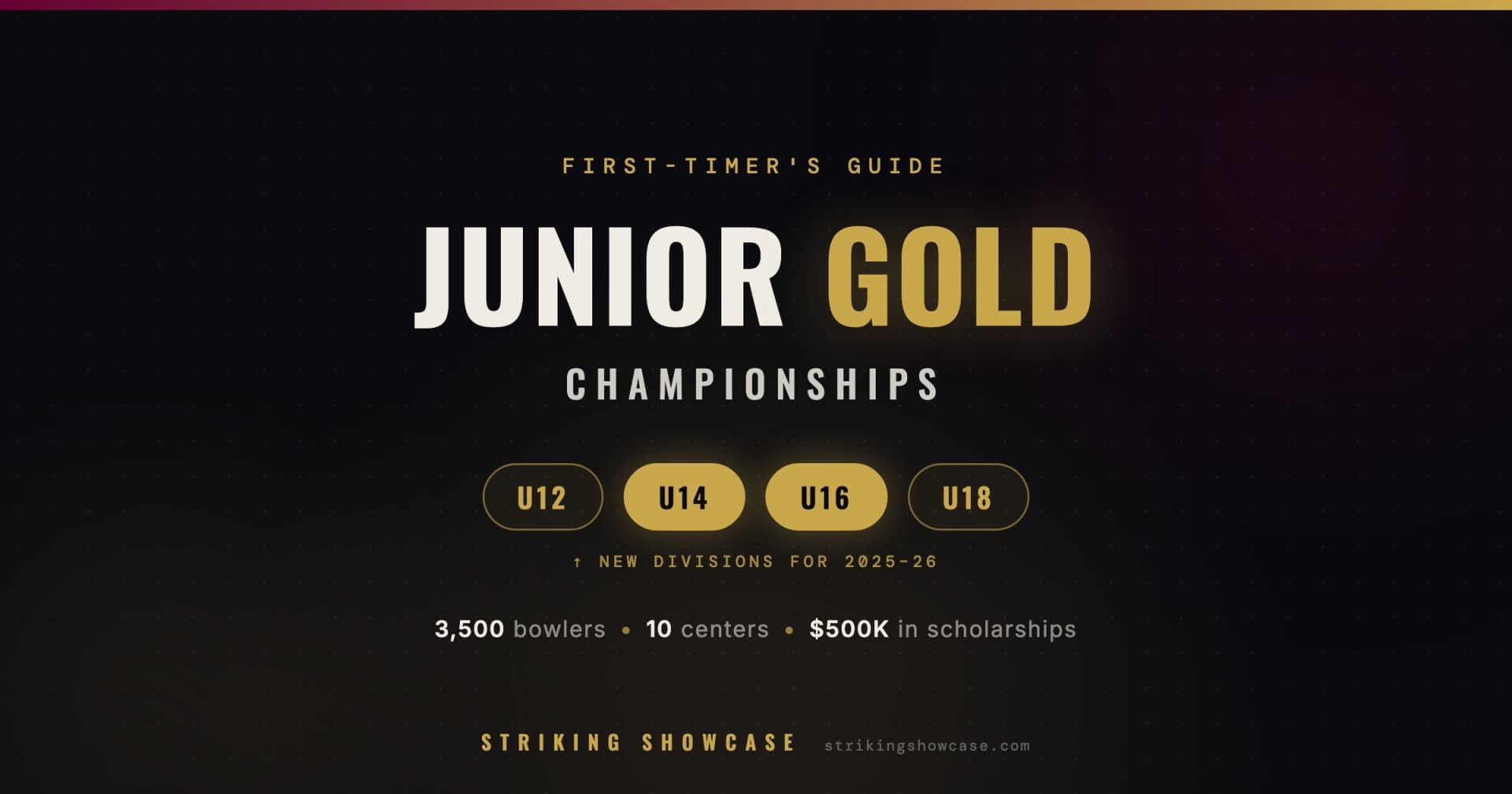
Nearly 3,500 of the best young bowlers in the country. Ten centers running qualifying and match play back to back. College coaches in the stands with a notepad instead of a program. That's Junior Gold — the biggest stage in youth bowling, and for a lot of recruits, the first time a college coach watches them compete in person. Show up unprepared and you're not just leaving pins on the table. You're leaving the moment on the table.
The format also just changed for this qualifying cycle. This guide breaks down what's different, how it actually works, and how to walk in ready — first trip or fourth.
What Is Junior Gold?
Junior Gold Championships is USBC's annual national youth tournament, and it just got a format refresh: starting with the 2025–2026 season, the event moved from three age divisions to four — U12, U14, and U16 join U18, replacing the old U12/U15/U18 split. USBC says the change is built for tighter, more even peer-to-peer competition. At the 2026 event in Minneapolis, nearly 3,500 athletes competed across 10 centers for close to $500,000 in scholarship money.
For a high school recruit, Junior Gold is essentially bowling's version of an AAU showcase. College coaches aren't watching from a bracket sheet at home. They're in the stands, live, deciding who gets a follow-up call.
How to Qualify
You earn your spot by bowling in a sanctioned local Junior Gold Qualifier (JGQ). That window also changed this season — qualifying now runs July 1 through May 1, instead of the old May-to-May cycle that used to overlap two seasons and confuse everyone about which year a bowler was qualifying for.
A few things that trip up first-timers
You need two active memberships before you can compete in any qualifier: a standard USBC Youth membership and a separate Junior Gold membership ($25–$50 depending on division). Buy both early — don't wait until the week of your qualifier.
Divisions are locked to your exact birth date, and there's no playing up to an older bracket. Confirm your division on bowl.com before you enter, not after.
Advancement rates aren't a flat percentage — they flex with the size of the field, roughly one qualifier for every four to ten entries depending on the event. Ask your qualifier director what the ratio looks like for your division going in.
Because the structure is new this season, double-check the current rules on bowl.com before you commit to a qualifier — details can shift as USBC rolls the changes out.
The Format, Quickly
At nationals, expect:
Four four-game qualifying blocks (16 games total), each on a different lane pattern
An advancers round — one more four-game block for U12, five games for U14/U16/U18 — followed by a second cut and another five-game stage
Double-elimination match play: two-game total-pinfall matches, highest pinfall moves on
Stepladder finals to crown each division champion
Practice sessions also got tighter this season — 30 minutes instead of 45, with Friday squads eliminated. That's less warm-up time to find your line, so lane-play prep before you get there matters more than ever. Every pattern is sport-compliant: flatter ratios, different oil distances, and none of the forgiveness of a house shot. Bowlers who only train on house patterns get exposed fast.
What to Expect as a First-Timer
The biggest shock isn't the competition. It's the volume. Between the qualifying blocks and advancer rounds, you'll bowl more games in one week than some bowlers throw in a month — and your hands, feet, and focus will be worn down well before match play.
Other first-timer realities:
Centers are loud, packed, and full of coaches roaming between pairs
Plan on three to five balls in the bag with different surfaces for different shots
Travel adds up fast — flights, hotels, meals, ball transport
The live leaderboard updates constantly, and watching it too closely will wreck your focus
College coaches really are watching — but they're clocking how you respond to a bad shot, not just how many you strike out
How Parents Can Help (Without Hurting)
The parents who help most at Junior Gold are the ones running logistics quietly and letting the bowler bowl. That means:
Pack snacks, water, extra socks, and ibuprofen
Stay off the approach between blocks — let your bowler reset on their own
Skip the coaching from the seats
Don't narrate the leaderboard during the day
Expect an emotional swing — celebrate the small wins, don't dwell on a bad block
If the goal is college recruiting, making the cut isn't the finish line. Bowling with composure, respecting the field, and looking like the teammate a coach wants on their roster — that's what actually moves the needle.
The Bottom Line
Junior Gold is the biggest stage in youth bowling and your best shot at getting seen by college coaches in person. Lock in your qualifier early, know your exact division, train for sport-compliant conditions instead of your house shot, and treat every block like a recruiting interview — because it is one.
Want coaches to find you before, during, and after Junior Gold — not just watch you from the stands? Build your Striking Showcase profile. Coaches use it to follow up on the bowlers who caught their eye at the event. Show off. Get recruited.
Frequently Asked Questions
What are the Junior Gold Championships age divisions?
Starting with the 2025–2026 season, Junior Gold moved to four divisions — U12, U14, U16, and U18 — for both boys and girls, replacing the previous U12/U15/U18 split. Eligibility is set by exact birth date, and bowlers can't play up to an older division.
What memberships do I need to qualify for Junior Gold?
Two: a standard USBC Youth membership and a separate Junior Gold membership ($25–$50 by division). Both need to be active before you bowl in any qualifier — get them squared away well ahead of your first event.
How many bowlers advance from a Junior Gold Qualifier?
There's no flat percentage. Advancement ratios flex with the size of the qualifying field — typically somewhere between 1-in-4 and 1-in-10 entries — so confirm the specific ratio with your qualifier director.
What if I missed my local qualifier?
Options vary by host association and year, so check bowl.com's Junior Gold page directly and early — spots and any last-chance options fill fast as the May 1 qualifying deadline approaches.
How many games will I bowl at Junior Gold nationals?
Qualifying is four four-game blocks (16 games) on different lane patterns, followed by advancer rounds — one more four-game block for U12, or five games with a second cut and another five for U14, U16, and U18 — before double-elimination match play and stepladder finals.
Do college coaches actually attend Junior Gold?
Yes. It's one of the few events where college coaches watch bowlers compete live, making it prime recruiting exposure — and they're watching composure under pressure as much as strike counts.
What should I bring to Junior Gold as a first-timer?
Three to five balls with different surfaces, plus snacks, water, extra socks, and basics like ibuprofen. Practice sessions are shorter this season (30 minutes, no Friday squad), and conditions are sport-compliant and tougher than a house shot — come ready to adjust fast.