How to Get Recruited for College Bowling: The 12-Month Roadmap
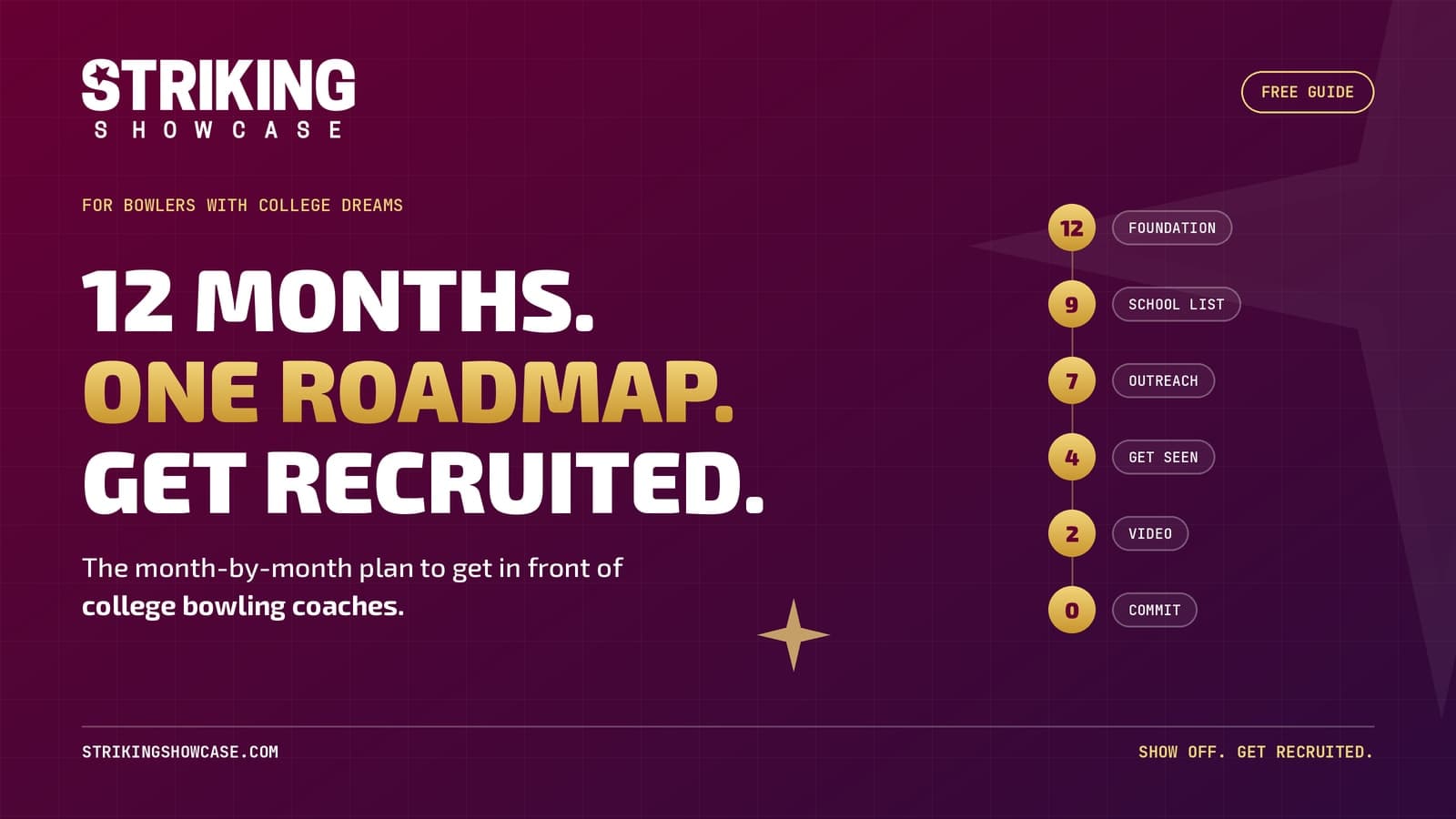
If you're wondering how to get recruited for college bowling, here's the short answer: build a complete recruiting profile, contact coaches early with your averages and academics, get evaluated at major tournaments, share a recruiting video — and do it all on a timeline, not at the last minute.
That last part is where most bowlers lose. Every year, talented athletes with 200+ averages watch roster spots and scholarship money go to bowlers they could beat — because those bowlers started earlier, stayed organized, and made themselves easy to find. Coaches work within signing periods, scholarship budgets, and recruiting calendars. The athletes who work the same calendar are the ones who stand out.
This roadmap walks you through the 12 months leading up to your commitment — typically your junior year into early senior year — month by month. Whether you're a sophomore planning ahead or a junior in the thick of it, you'll know exactly what to do, when to do it, and what college bowling coaches expect at every stage.
Why Timing Matters in College Bowling Recruiting
Bowling recruiting doesn't happen in one dramatic moment. It's a long conversation — and coaches start that conversation earlier than most families realize. By the time signing day arrives, most rosters were shaped 12–18 months before.
Starting early gives you three advantages:
Relationships take time. A coach who has watched you compete, improve, and communicate for a year trusts you more than a name that appeared in their inbox in April of senior year.
You can show progress, not just a snapshot. An average that climbs from 195 to 208 over twelve months tells a coach more than a single number ever could.
Scholarship money runs out. Bowling budgets are small. The families who wait are choosing from what's left.
The most common mistakes? Waiting for coaches to find you, sending one generic email blast to thirty schools, and treating the recruiting video as the whole strategy instead of one piece of it. This roadmap fixes all three.
New to the process? Start with our overview of college bowling recruiting to understand how the system works before you dive into the timeline.
The 12-Month Recruiting Timeline at a Glance
Months 12–10: Build Your Recruiting Foundation
Before you contact a single coach, get three things working for you: a complete recruiting profile, current sanctioned averages, and recent tournament results.
Create a complete recruiting profile
Your profile is your recruiting home base — one link that answers every question a coach has.
Create your Striking Showcase profile and load it with:
Graduation year and contact information
USBC sanctioned averages (league and tournament)
Youth and high school tournament results
GPA, transcript, and ACT/SAT scores if available
A professional action photo
Write a short personal statement
Three or four sentences: who you are, where you bowl, and what you want to accomplish at the collegiate level. Coaches read hundreds of profiles — a clear, confident introduction is memorable precisely because it's rare.
What coaches expect at this stage
Not a highlight video. Not a hype reel. They want to find you easily, see your numbers and academics in one place, and get the sense that you take the process seriously. That's it. The profile does that job while you sleep.
Months 9–8: Build Your School List
Now narrow the field. Aim for 15–25 programs sorted into three tiers:
Reach schools — programs where you'd need a strong year to earn a spot
Match schools — programs where your averages and academics fit the current roster
Likely schools — programs where you'd contribute from day one
Know the two paths: NCAA and USBC Collegiate
This is where bowling differs from most sports.
NCAA bowling is a women's varsity championship sport, and those programs can offer athletic scholarships.
USBC Collegiate club programs include men's, women's, and co-ed teams competing at hundreds of colleges nationwide — and many club programs offer academic scholarships or other financial aid.
Both paths produce great collegiate careers; know which ones apply to you before you build your list.
Research beyond the banner
For every school on your list, dig into:
Academic programs
Team culture
Coaching staff
Conference
Roster size
Graduation rates
The best fit isn't always the biggest bowling name — it's the place where you'll succeed as a student and an athlete for four years.
If money is part of the decision, study bowling scholarship programs available at each tier before you finalize your list.
Months 7–6: Start Contacting College Coaches
This is where most families hesitate. Don't. By the end of this window, you should have introduced yourself to every coach on your list.
What to put in your first email
Graduation year
USBC average
GPA and test scores (if available)
Two or three recent tournament finishes
One line on why their program interests you
A direct link to your recruiting profile
Keep it under 150 words. Coaches don't need your life story — they need a reason to click your profile.
Personalize or don't bother
Coaches spot a copy-paste email instantly, and it tells them exactly how interested you are.
One specific sentence — about their roster, conference finish, or academic program — is worth more than three paragraphs of generic enthusiasm.
Follow up with a reason
Silence doesn't mean no. Follow up after:
Major tournaments
Strong finishes
Career-high series
Improvements in your average
Every update is another reason for a coach to remember your name.
Months 5–4: Get Evaluated in Person
Emails open doors. Tournaments walk you through them.
College coaches evaluate athletes at:
Junior Gold Championships
USBC Youth Open Championships
Storm Youth Championships
High school state championships
Elite Youth Tour (EYT) majors
College camps and unofficial visits
Tell the coaches you've been emailing which events you'll be at. A coach who already knows your name and numbers will make time to watch you bowl.
What coaches watch beyond the scoreboard
When coaches are in the building, don't bowl differently — they're not just counting strikes.
They're watching:
Attitude
Sportsmanship
Communication with teammates and officials
How you recover after a bad frame
How you respond to coaching
A composed 190 game after a rough start often says more than a front-nine run. They're recruiting a four-year teammate, not a single tournament score.
Months 3–2: Recruiting Video and Serious Conversations
Build a video coaches actually want
Keep it two to three minutes and let your game speak:
Full-approach shots from behind and from the side
Multiple lane conditions if possible
Spare conversions
Minimal editing
No music-video effects
Coaches evaluate your physical game, your ball roll, and your repeatability — not your editing software.
Reconnect and go deeper
Send the video to every coach you're actively talking to.
As conversations get serious, expect:
Phone calls
Video meetings
Campus visits
Come with real questions:
Academic support
Practice schedules
Travel expectations
Team culture
Where the program is headed
These conversations are interviews in both directions — you're choosing them too.
Months 1–0: Choose the Right College
If you've followed this bowling recruiting timeline, you'll likely have real options.
Compare every offer on five dimensions:
Academic fit — does the school have your major, and will you thrive there?
Athletic opportunity — will you compete, develop, and be pushed?
Financial reality — total cost after every scholarship and aid package
Coaching philosophy — do you trust this staff with four years of your career?
Campus environment — could you be happy here even in a bad bowling week?
The biggest name or the biggest offer isn't automatically the right answer. The right program is the one where you'll grow as a student and an athlete.
When you decide, complete your school's commitment and financial aid paperwork — and then personally thank every coach who invested time in you. Bowling is a small world. The coaches you turn down today will be across the lanes from you for years.
Final Thoughts: Preparation Beats Perfection
Learning how to get recruited for college bowling isn't about being a perfect bowler. It's about being a prepared one.
Start early. Stay organized. Communicate consistently. Give coaches everything they need to evaluate you — before they have to ask for it.
At Striking Showcase, we believe recruiting should be transparent and athlete-first. The bowlers who win this process aren't always the highest averages in the building. They're the ones coaches can find, evaluate, and trust.
Ready to start your 12 months?
Build your free athlete profile on Striking Showcase — your scores, tournament results, academics, equipment, and highlight video in one professional profile that gives college coaches a single place to evaluate your potential.
Show off. Get recruited.
Frequently Asked Questions
When should I start preparing for college bowling recruiting?
No later than the summer before your junior year. Coaches build recruiting classes 12–18 months out, so a sophomore or early junior with a complete profile has a real head start on a senior starting from zero.
What should a college bowling recruiting profile include?
Graduation year, sanctioned USBC averages, tournament results, GPA and test scores, contact information, a recent action photo, and a highlight video — all in one link a coach can open in thirty seconds.
Do college bowling coaches contact athletes first?
Sometimes — but most successful recruits make the first move. Bowling staffs are small and recruiting budgets are smaller, so the athletes who introduce themselves and keep sharing updates get evaluated first.
Are there scholarships for college bowling?
Yes. NCAA women's programs can offer athletic scholarships, and many USBC Collegiate club programs offer academic scholarships, institutional aid, or bowling-specific awards. SMART scholarship money earned in youth bowling can help too.
How often should I update college coaches?
When you have something worth sharing — a new average, a strong finish, a better GPA, or a new video. For most bowlers that's every four to six weeks in season. Meaningful updates keep you on the board without flooding a coach's inbox.