Does NCAA Bowling Offer Scholarships? A 2026 Breakdown for Athletes and Parents
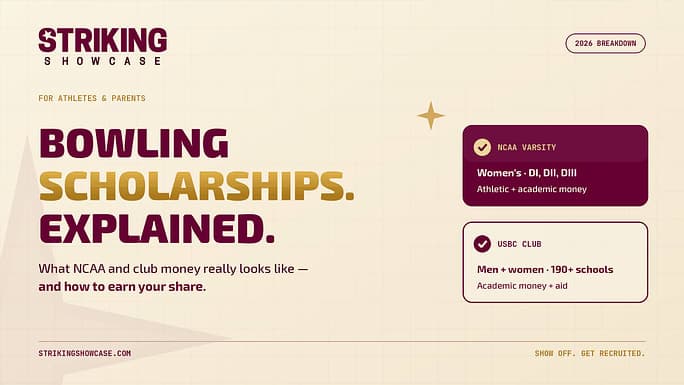
By Diandra Asbaty, two-time collegiate national champion & founder of Striking Showcase · Updated July 1, 2026
Short answer: yes. NCAA bowling scholarships are real — but they don't work the way most families expect, and the rules just changed in a big way.
Search this topic and you'll find two kinds of wrong answers: articles that make it sound like every recruited bowler gets a full ride, and articles that make it sound like bowling money barely exists. The truth sits in between — and the families who understand how the money actually moves are the ones who negotiate the best packages.
Here's the 2026 breakdown: what NCAA bowling is, how scholarships are awarded under the new rules, what the USBC Collegiate club pathway offers, and how to make yourself the recruit coaches want to fund.
Understanding NCAA Bowling Scholarships
Start with the fact that surprises most families: NCAA bowling is a women's championship sport only. There is no NCAA men's bowling. Women's programs compete across Divisions I, II, and III, and they battle for conference titles and a national championship every season.
Because these are NCAA programs, schools can award athletic scholarships — with one major exception. Division III schools do not offer athletic scholarships in any sport. DIII bowlers get funded through academic and merit aid instead, and those packages can still be substantial. If a DIII coach is recruiting you, that's the conversation to have.
At DI and DII programs, recruits rarely get one big athletic check. They get a package — athletic money layered with academic scholarships and need-based aid. Keep that word in mind, because it's the key to this entire topic.
New to the process? Our overview of college bowling recruiting covers how the whole system works.
How Athletic Scholarships Are Awarded — and What Changed in 2025
For years, NCAA women's bowling operated under an equivalency cap: each program could award the equivalent of five full scholarships, split across the whole roster.
That rule has changed. Under the House v. NCAA settlement, which took effect July 1, 2025, Division I schools that opted into the settlement no longer have sport-by-sport scholarship caps. Instead, each sport has a roster limit — 11 for women's bowling — and schools can fund as much or as little of that roster as their budget allows. Division II programs still operate under the traditional equivalency limits.
Here's what didn't change: budgets are still finite, and full rides are still the exception. Whether the cap is a rule or a budget line, coaches stretch their money across the roster. Most bowlers receive partial athletic aid, which coaches combine with:
Academic scholarships
Need-based financial aid
Institutional grants
Merit-based awards
So when you talk to a coach, don't ask "what percentage scholarship do I get?" Ask: "What does my total financial aid package look like?" That question marks you as a family that understands the process — and it gets you a real answer.
One important caveat: these rules are still evolving, and college athletics is changing faster right now than at any point in decades. Before you make decisions based on scholarship or roster rules, verify the current details at NCAA.org, NAIA.org (NAIA schools field bowling programs too, with their own scholarship rules), or BOWL.com for USBC Collegiate — and confirm anything that matters directly with the coach.
The USBC Collegiate Club Pathway
NCAA varsity isn't the only way to bowl in college — or the only way to get help paying for it.
USBC Collegiate club programs field men's, women's, and co-ed teams at more than 190 institutions across the country. These programs don't award NCAA athletic scholarships, but many of their schools provide real money through academic scholarships, institutional aid, booster support, and bowling-specific scholarship funds.
Some club packages compete head-to-head with NCAA offers — the funding just comes from different sources.
What this means by athlete:
Women have two paths: NCAA varsity programs and USBC club programs. Cast a wide net across both.
Men have strong options too. There's no NCAA men's bowling, but NAIA and NJCAA programs can offer athletic aid, and USBC Collegiate programs offer academic and institutional aid. The competition at the top is serious at every level.
If the varsity route is your goal, our guide to NCAA bowling recruiting breaks down what those coaches expect.
How Much Bowling Scholarship Money Can You Actually Receive?
There's no standard number — and anyone who quotes you one is guessing. Your bowling scholarship money depends on:
Your academic record (this moves more money than most families realize)
Tournament experience and results
What the team needs the year you graduate
The program's scholarship budget
Financial need
The rest of the recruiting class
Top recruits can earn significant athletic aid. Plenty of others receive modest athletic awards stacked with strong academic scholarships that cut their real cost more than the athletic money does.
The rule: compare total packages, not scholarship percentages. A 40% athletic scholarship at an expensive school can cost your family more than a 15% award plus academic money somewhere else. The only number that matters is what you'll actually pay.
Who Qualifies for College Bowling Scholarships?
There's no magic average that unlocks a scholarship. Coaches are funding a four-year investment, and they evaluate the whole athlete:
Tournament performance and consistency
Work ethic and coachability
Leadership and character
Academic achievement
How you compete under pressure
A bowler who performs consistently, communicates like a professional, and carries strong grades routinely out-recruits someone with a slightly higher average and a weaker overall profile. Coaches have watched talent flame out. They fund reliability.
Academic Success Is Scholarship Money
Here's the opportunity most families leave on the table: for the majority of college bowlers, academic scholarships are the largest piece of the financial aid package.
A strong GPA, challenging coursework, and solid test scores do two jobs at once — they reduce your cost directly, and they make you a more attractive recruit, because academic money you bring with you stretches the coach's athletic budget further.
Coaches actively prefer recruits whose grades travel well.
If you're chasing college bowling scholarships, your GPA is part of your game. Treat it that way. Then explore the bowling scholarship programs available at every level to see how the pieces stack.
Women's Bowling Scholarships Keep Growing
Collegiate bowling is expanding, and more schools are investing in women's programs every year — which means more women's bowling scholarships than any previous generation of bowlers had access to.
More opportunity doesn't mean less competition. Coaches want athletes who show maturity, support teammates, and compete with confidence. Build relationships early, keep your recruiting profile current, and understand what programs expect before you start the conversation. Our guide to women's college bowling recruiting is the place to start.
Three Moves That Improve Your Scholarship Opportunities
Build a complete recruiting profile. Averages, tournament results, academics, and video in one link a coach can open in thirty seconds. Coaches fund athletes they can evaluate.
Contact coaches early. Scholarship budgets get committed 12–18 months out. Follow the 12-month recruiting roadmap so you're in the conversation before the money is spent.
Protect your GPA. It's the one scholarship factor entirely in your control, and it stacks with everything else.
Final Thoughts: Chase the Package, Not the Percentage
Understanding NCAA bowling scholarships isn't about memorizing one dollar figure. It's about seeing every funding source on the table — athletic, academic, need-based, institutional — and finding the program where the total package and the fit are both right.
Whether you're pursuing an NCAA women's program or a USBC Collegiate club team, preparation is what separates funded bowlers from frustrated ones. Keep your academics strong. Compete consistently. Communicate with coaches early. And make yourself easy to evaluate. Since the rules keep changing, make checking NCAA.org, NAIA.org, and BOWL.com part of your recruiting routine.
That last part is where we come in. Build your free athlete profile on Striking Showcase — your scores, tournament results, academics, equipment, and highlight video in one professional profile that gives college coaches a single place to see your potential.
Show off. Get recruited.
Frequently Asked Questions
Can you get a full NCAA bowling scholarship?
Yes, but full rides are the exception. Even with caps lifted at many DI schools, coaches spread limited budgets across the roster — most bowlers receive partial athletic aid combined with academic and other assistance.
Are college bowling scholarships available for men?
Yes. There's no NCAA men's bowling, but NAIA and NJCAA programs can offer athletic aid. Men's USBC Collegiate programs are often supported by academic scholarships, institutional aid, and bowling-specific funds.
What average do coaches look for?
There's no minimum average that automatically earns a scholarship. Coaches evaluate tournament results, consistency, academics, work ethic, coachability, and pressure performance — the whole athlete, not one number.
Can academic scholarships increase my total financial aid?
Yes — for most college bowlers, academic money is the biggest piece of the package. Strong grades stack with athletic aid and can dramatically cut your cost of attendance.
When should I start preparing for college recruiting?
No later than the summer before your junior year. Coaches commit scholarship money 12–18 months ahead — the families who wait are choosing from what's left.