When Should Bowlers Start the College Recruiting Process? Sooner Than You Think
This question shows up in almost every bowling parent's first conversation about college: When should we actually start?
The honest answer makes a lot of families uncomfortable: earlier than you think — but lightly. The bowlers who end up with the most offers and the best packages aren't always the ones with the highest averages. They're the ones who started building a recruiting foundation while they were still figuring out the sport, so they walked into junior year already known.
Here's the grade-by-grade truth.
8th Grade and Younger: Don't Recruit. Just Bowl and Build Habits.
Coaches aren't scouting 7th graders for scholarships — that's a matter of practice, not an NCAA rule. Bowling doesn't have the tight, sport-specific recruiting calendar that locks down when football or basketball coaches can first reach out — it falls under the NCAA's general "all other sports" rules, which means there's no rule barring a college coach from talking to a 13-year-old, aside from a short NCAA-mandated dead period each year (timing varies slightly by division). What actually happens is simpler: coaches are watching who shows up at major youth tournaments year after year, and building that track record now is the real work — it just doesn't look like recruiting yet.
What "starting" means in middle school:
Bowl in sanctioned USBC leagues so you have a documented average
Compete in at least one major youth tournament a year
Take the academic side seriously — your GPA starts mattering long before you think it does
Skip the outreach to college coaches. It's not against the rules, but an early email from a middle schooler (or a parent) tends to read as over-eager rather than recruit-ready
The goal at this age is to fall in love with the sport, build clean fundamentals, and stay academically strong. That's the entire job.
Freshman Year: Build the Foundation
Freshman year is when families should quietly start the recruiting infrastructure — not the outreach, the infrastructure.
This means:
Set up a recruiting profile (Striking Showcase or another platform). Even if you don't share it publicly yet, you'll need somewhere to log every tournament result, average, and milestone going forward. Coaches who research early reward bowlers with documentation.
Start tracking your USBC averages by season, by tournament, and by lane condition.
Get a credible action photo. Not posed. Filmed at a real tournament, mid-approach.
Begin researching schools. Build a casual list of 15–20 programs across NCAA Women's Bowling, NAIA and NJCAA varsity programs (both offer men's bowling, which NCAA doesn't sponsor), and USBC Collegiate Club that interest you academically, geographically, and athletically.
You're not contacting coaches yet. You're getting ready to.
Sophomore Year: Start Showing Up on Coaches' Radar
Sophomore year is when recruiting activity actually starts to ramp up — not because a rule flips on, but because this is when coaches shift real attention toward your class and families who've done the groundwork start showing up on the radar.
Because bowling doesn't have a sport-specific NCAA contact calendar, a coach can respond to you at almost any point in the year — and you, the recruit, can always reach out first, at any age (a coach's ability to respond during the brief annual dead period is what's limited, not your ability to send the email). So there's nothing stopping a motivated sophomore from making first contact; it's just that most families aren't ready to make it count until now.
What to do:
Attend at least two major youth tournaments — Junior Gold, Storm Youth Championships, the USBC Youth Scratch Championships presented by SMART (formerly the Pepsi Championships), or top Elite Youth Tour events.
Send your first introductory emails to coaches at programs that interest you. Keep them short, personal, and informational — not asking for a scholarship, just introducing yourself.
Take the PSAT seriously. NCAA Division I and II no longer require ACT/SAT scores for athletic eligibility, but a strong score still matters — it drives academic scholarship money and keeps you competitive at schools that consider it in admissions.
Update your recruiting profile after every major tournament.
By the end of sophomore year, you should have had at least a handful of email exchanges with college coaches and started to identify which programs are genuinely interested.
Junior Year: This Is the Recruiting Year
Junior year is the most important recruiting year for the vast majority of college bowlers. Coaches build their classes here. Offers start coming in. Money gets allocated.
If you've done the work in freshman and sophomore year, junior year is when:
Coaches invite you on unofficial visits
You take the ACT or SAT (no longer an NCAA D1/D2 eligibility requirement, but academic scholarship money often hinges on it)
You attend showcase events with coaches watching you live
You film and circulate your first true recruiting video
You start receiving verbal offers from programs
If you're a junior and haven't started any of this — don't panic. But don't wait another month, either. Set up your profile this week.
Senior Year: Decision and Signing
By senior fall, the bowlers who got organized earlier are choosing between offers. The bowlers who waited are scrambling.
Senior year is for:
Official visits
Final program comparisons (academic fit, athletic fit, financial fit)
Signing your financial aid agreement (the NCAA retired the National Letter of Intent in 2024 — NCAA programs now use written athletics aid agreements) or commitment paperwork (NAIA, NJCAA, or USBC Collegiate Club)
Preparing physically and mentally for the college level
If you're a senior just starting now, there's still time — but you'll be working from a shorter list of programs that still have roster spots and aid available than there would have been a year ago.
The Bottom Line by Grade
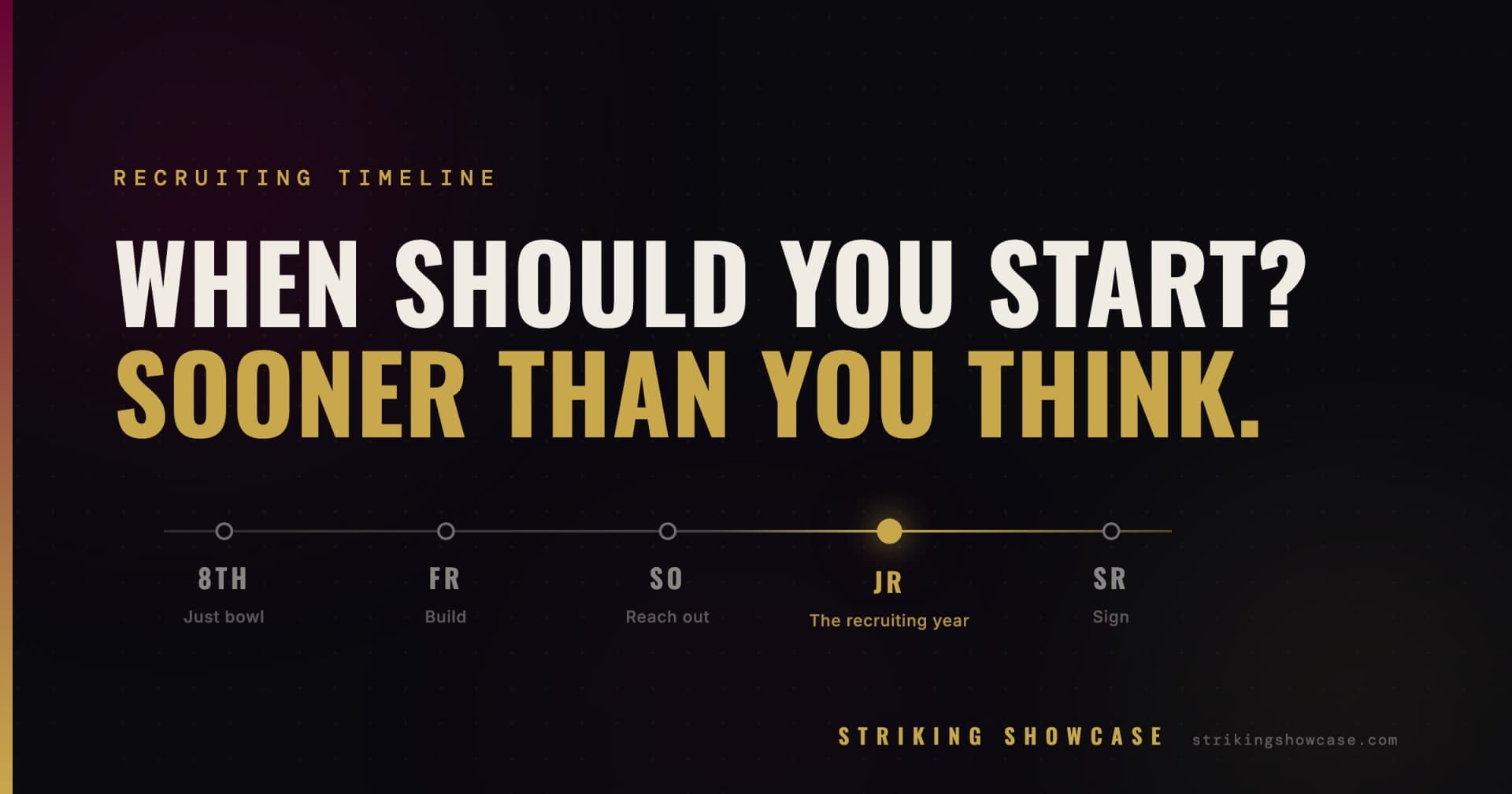
8th and younger — Bowl. Build habits. Take academics seriously. Hold off on coach outreach. Freshman — Build your profile, track averages, research schools. No outreach yet. Sophomore — First coach emails. Attend major tournaments. Update profile constantly. Junior — The recruiting year. Visits, video, offers. Senior — Choose, sign, prepare.
The Honest Truth
Bowlers who start the process as freshmen don't get recruited earlier because they started early. They get recruited better — because they're more prepared, more documented, and more visible by the time coaches are actively making decisions.
The cost of starting too early is almost nothing. The cost of starting too late can be tens of thousands of scholarship dollars and the school you actually wanted — and increasingly, it can mean missing out on NIL opportunities too, since sponsors and boosters tend to notice the bowlers who are already visible.
Start your profile now — even as a freshman. Build your Striking Showcase profile and get on coaches' radar before the class ahead of you closes the door. Show off. Get recruited.